Showing posts with label Energy. Show all posts

Wednesday, March 18, 2009

Another Year, Another Call for Water Rationing in California...

Even though it's been rainy on and off for the past month or so, I keep seeing articles in the news, like this one from the New York Times, about the drought that California is going through. Apparently, rain has been hitting the Bay Area but not really much else... for three years running. The Times article talks a lot about the impact of the drought on farming communities in the Central Valley (less rain = fewer crops = fewer jobs) and the intensification of hardships that out-of-work farmers face because of the Financial Crisis.

Along with the drought comes the annual call from the governor's office to ration water. Just two weeks ago:
The governor called for a statewide water conservation campaign and asked all urban water users to immediately reduce their individual water use by 20 percent.
After I read about the call for water rationing, I started wondering to myself,

How much of a difference does 20% of my personal water usage make?
  • From the U.S. Geological Survey: In 2000, the U.S. used 408 billion gallons of water in total per day
  • 43 billion gallons per day were used for the "Public Supply" (that's like plumbing and water fountains)
  • From the Environmental Protection Agency: About half of the Public Supply goes to residences, people's homes (the other half goes to office buildings, schools, etc)
    • That means that about 21.5B gallons per day were used residentially in 2000 (ie 1/2 of 43B gallons)
  • 21.5 billion gallons (Residential) ÷ 408 billion gallons (Total) = 0.0526 = ~5%
    • Residential water use in the U.S. accounts for about 5% of total water usage
Just 5% of total water usage is in people's homes, and yet the governor is asking us to tighten our belts. Don't get me wrong, we should be trying to minimize our personal water consumption all the time, not just during droughts. However, since residential consumption is such a small part of the total, if we all reduced our personal (ie residential) consumption by 20%, that would still only mean a 1% reduction over all for total water usage.
  • 20% (reduction in residential usage) of 5% (residential usage as percent of total usage)
    • 20% of 5% = .20 x .05 = .01 = 1%
This all is just to demonstrate that residential water consumption is just a drop in the bucket, so to speak. Reducing water usage is a good habit to have, however the real water usage is clearly elsewhere.


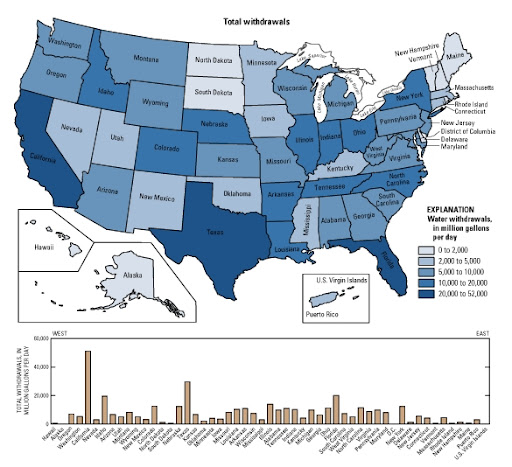
CA is by far the largest water-consuming state, dwarfing even TX, the second largest

Where is all the water going?

There two major uses of water: agriculture and electricity. It makes sense that a lot of water would go to farming; crops need clearly need it. Indeed, Governor Schwarzenegger is asking us to reduce our personal water consumption, so that more water can be directed towards irrigation. The present drought means that the sky isn't providing the water crops need in the form of rain. The other major use of water is the less obvious one: electricity. The majority of electricity in the U.S. is produced in Fossil Fuel burning power plants. These plants burn coal or oil to produce a great amount of heat, which is used to boil water. The steam from the water spins a turbine, which as it rotates creates electricity.
  • As was stated earlier, 408B gallons are consumed per day
  • 137B gallons go to Irrigation
    • 137B ÷ 408B = .3357 = ~34%
  • 196B gallons go to Power Plants
    • 196B ÷ 408B = .4803 = ~48%
  • So, Irrigation accounts for 34% of the Total U.S. water consumption, whereas Electricity accounts for 48%

If we really are serious about cutting down the amount of water that is consumed, not just in California but in the whole U.S., we need to consider more than just residential use. Cutting residential use by 20% could save up to 4 billion gallons of water per day: that's a HUGE amount of water we are just flushing away!

However, to really save water, we need to move away from Fossil Fuel burning Power Plants. Not only do they account for almost half of U.S. water consumption, but they produce Green House Gases that contribute to Global Warming. There are alternative modes of electricity production that use significantly less water and produce no Green House Gases. While we're at it, we should reconsider our farming practices which create a great deal of Green House Gases as well. Now is the time to really examine how we, as a state and country, use our resources and impact the environment.

[Note: For the most complete breakdown of U.S. water consumption by state and end-use, check out this chart from the U.S. Geological Survey. It provides a much more complex picture for changing our state and national priorities.]

Friday, January 30, 2009

Stop Taking Your Breakfast for Granted!


3.75

That's how many pounds of Carbon Dioxide are released into Earth's atmosphere for every carton of Tropicana Orange Juice. To give you an idea of what it means in terms of pollution: Cars make about 1 pound of Carbon Dioxide for every mile driven. Each carton of Tropicana OJ that you buy is like driving a car for almost 4 miles. The name that scientists give to the amount of Carbon Dioxide (and other harmful Green House Gases) connected to a particular product is its "Carbon Footprint."

[Note: Check out my last post on calculating your own Footprint -- the approximate Green House Gases from all the goods and services you buy each year.]

What goes into each carton's Footprint?

As I mentioned above, the Carbon Footprint refers to some amount of Carbon Dioxide, which contributes to Global Warming. The largest sources of Carbon Dioxide in the atmosphere are Fossil Fuels. (Some examples of theses Fuels include Oil and Coal, and products made from them like Gasoline.) Two major characteristics of Fossil Fuels that scientists have known and taken advantage of for years are that 1) they release a great amount of heat energy when set on fire and 2) they have lots of Carbon in their chemical make-up.

When Fossil Fuels are burned, the Carbon that is contained in them transforms into Carbon Dioxide and floats off in a cloud of smoke. Just so you know: Most of the electricity in the U.S. is produced by Fossil Fuel-burning power plants -- that is, about 72% of all U.S. electricity. (Only 8.5% is created by Renewable Resources, like Solar and Hydro Power.) And don't forget how much Gasoline (made from Oil) we burn every day driving our cars around! (I would also like to point out that most Plastic is made from Oil and has a large Carbon Footprint as well.)

A Carbon Footprint calculates things like how much Carbon Dioxide is made while producing the electricity used in Tropicana's factory. It also includes the Carbon Dioxide from burning Gasoline while shipping the cartons of juice across the country (usually from the main plant in Bradenton, Florida). You can probably tell already how hard it is to calculate a Carbon Footprint: you have to figure out every step of the process and then calculate the Carbon Dioxide associated with it. The hardest part can be figuring out just what all the steps in the process are.

A Surprise in the Calculation

To calculate their Carbon Footprint, Tropicana hired an outside company, called Carbon Trust:
Early on, [Tropicana's own] company officials roughed out the carbon footprint of Tropicana juice. But when the Carbon Trust came back with its own calculations, that initial estimate was off by more than 20 percent.

Growing the oranges accounted for a larger share — about a third — than [Tropicana] had expected, almost entirely because of the production and application of fertilizer.
So Tropicana's own people made a guess at their Footprint, but like I said, it's hard to figure out all the steps in the process. The professionals they hired from Carbon Trust found a step the Tropicana people left out: growing the oranges.

Tropicana discovered something that Environmentalists have known for a while now: Farming makes a lot of pollution. The majority of Carbon Dioxide produced in farming comes from its fertilizers. Most of the nutrients in the fertilizers are made from Fossil Fuels. In 2005, 99.5% of farms in America use fertilizers made in a lab. Just the process of making the fertilizer releases a huge amount of Carbon Dioxide. (These chemical fertilizers -- and other elements of modern farming -- have further negative effects on the environment, but for this blog post, let's just stick to the Carbon Footprint.)

Breaking Down the Footprint

Here's Carbon Trust's breakdown of the Carbon Footprint:

As it turned out, the production phase of the juice alone accounts for 60% of the Carbon Footprint. Of that, 58% comes from the fertilizer.
58% of 60% = .58 x .60 = .348 = ~35%
So, about 35% of the orange juice's Footprint comes from the chemical fertilizer used to grow the oranges. That's more than the Electricity and Natural Gas (another Fossil Fuel) used to power the factory in processing the oranges! That's more than the fuel used by trucks and trains to drive it across the country!

The way Carbon Trust came to the number 3.75 pounds was by adding up all of the Carbon Dioxide emitted by all of these processes over the course of 6 months or a year and then divided by the number of cartons produced in that time. Consider this scenario: A single batch of orange juice made from the same harvest of oranges is split into two trucks. One truck full of orange juice drives from the main Tropicana plant to somewhere else within Florida. The other truck drives all the way out to California. Since the second truck drove farther, does that mean that its orange juice has a larger Carbon Footprint?

The answer is: No, since Tropicana is a national company and it uses profits in one area of the country to balance out costs in another. That helps them to deliver a uniform brand product with the same quality and price nationwide. But it also means that the cost of fuel and therefore the fuel's Carbon Dioxide is distributed over all the cartons of juice that Tropicana sells.

Does this mean that Tropicana is bad for the environment?

Let me put it this way: "Bad for the environment" is relative. As I said before, the biggest part of the juice's Carbon Footprint comes from the chemical fertilizer that is used, and remember that 99.5% of farms in America use these fertilizers. That means 99.5% of oranges, corn, wheat, rice, grapes, and all other types of produce have this large Carbon Footprint due to chemical fertilizers. You may be wondering now what that other .5% of American farms is: Organic Farms.

If you go to a supermarket and head to the produce section, you'll find that there are many types of fruits and vegetables available. And next to each variety, you may (though maybe not) find the same kind but with the label "Organic." Organic blueberries. Organic corn. It's the same type of food, but grown without chemical fertilizers (and without pesticides). This means that these organic foods have much smaller Footprints.

Something else that can reduce a product's Carbon Footprint is not driving it halfway across the country, burning up gasoline. Locally grown foods don't have to travel nearly as far. There are big Farmers' Markets that happen in Richmond and Oakland every weekend.

In Richmond, the Farmers Market is every Friday, 11am-5pm:

Richmond Public Library (parking lot)
325 Civic Center Plaza
Richmond, CA

[Note: I just went there and bought a blood orange (oranges that are red inside) and strawberries.]

The other big way to reduce the Carbon Footprint of your foods is buying less processed stuff. The more that food has to go through machines and factories, the more electricity has to be used. You can minimize the Carbon Footprint of your orange juice by buying California-grown, organic oranges and squeezing them yourself, then just keep a pitcher of it in your fridge.

But getting back to the original question: Tropicana's orange juice is probably no worse than any other company's: they all use chemical fertilizers and ship around the country. Tropicana, however, has taken the first step to reduce their Carbon Footprint, and which no other company has done: figuring out just what their Footprint is.
Wednesday, January 21, 2009

Alternative Energy in the Economic Downturn

From the New York Times's Green Inc. blog:
OptiSolar, based in California, is laying off close to half of its workers at what it had hoped would become a huge solar-panel plant near Sacramento.

HelioVolt, a [...] solar manufacturer headquartered in Austin, is also cutting jobs, as reportedly is SunEdison.

Evergreen Solar, a solar manufacturer, announced that it would close down a pilot plant in Massachusetts as a cash-saving measure; it will incur a $25 million charge for writing off equipment.
All of those (hyperlinked) company names are different companies that manufacture solar panels and things like that. And, as you probably noted, they are all suffering right now, during the Financial Crisis.

According to USA Today, there are several reasons why:
Since 2004, solar prices have been propped up by a shortage of capacity to make both silicon — the raw material for solar-power systems — and finished panels. Meantime, the Spanish and German governments have paid system owners hefty subsidies to generate solar power, turbocharging sales in those countries.

Manufacturers responded by building a wave of factories. Then Spain and Germany slashed this year's incentives [ie the subsidies]. In the U.S., the biggest solar investors were banks such as Morgan Stanley that can no longer benefit from tax credits because of insufficient profits.
Prices on solar panels had been pushed artificially high, since 2004. However, the Financial Crisis, last fall, slammed the brakes on everything: no one is buying solar panels and Germany and Spain stopped their subsidies. Even in the U.S. investment capital is slim. This has had two major results:
  1. The wave of factory closings mentioned earlier.
  2. Prices are much lower on the solar panels that are still being produced.
    • There were so many factories producing as many panels as they could, for the past few years, that there are a ton of panels just lying around right now. Factory owners are more or less trying to get rid of them.
    • At the same time as that high level of supply, there is extremely low demand.
Barry Cinammon, CEO of Akeena Solar, one of the nation's largest installers, estimates that the total cost for consumers buying solar panels has fallen 8%. And representatives from SunPower, one of the largest solar manufacturers, predict that prices may fall by as much as 20%.

The news isn't so bad though, if you're a consumer in the Golden State. From the USA Today article:
In California, which accounts for nearly 70% of the U.S. solar market, a typical 4-kilowatt, $32,000 solar energy system cost a homeowner about $23,000 last year after state and federal incentives [ie more government tax credits]. This year, if prices sink as expected, that system is likely to cost $10,000 to $12,000.
The point here is that if you're thinking about buying solar panels for your roof, the time to do it is now.

But even though the math has been sounding pretty negative for solar companies, there is good news in the long term. According to an article from the Wall Street Journal:
Start-ups across a variety of areas -- solar power, biofuels and energy conservation among them -- are getting increased financing from venture capitalists and lenders at a time when other small companies are cutting back and being turned away by investors. And many are hiring more staff, boosting marketing efforts and expanding geographically.[...]

While the overall volume of venture-capital deals sank last year, investments in clean-technology companies totaled $8.4 billion, up nearly 40% from 2007, according to Cleantech Group. In the third quarter alone, venture capitalists poured $2.6 billion into clean technology, a quarterly record. In the fourth quarter, they invested $1.7 billion.
Even though venture-capital as a whole was declined last year -- no doubt as a result of the Financial Crisis -- it went up by 40% for the Alternative Energy sector. The article goes on to interview owners of alternative energy retailers, manufacturers, and installers who are expecting their business to grow in the next few years.

How does this reconcile with the problems that the solar companies are facing? Solar technology is just one source of alternative energy. The WSJ article deals with everything from Biofuels to Information Technology:
Verdiem Corp. sells software that provides centralized control over power consumption, such as remotely turning off computer monitors left on overnight.
Solar got popular very quickly, but as it turns out, we're going to need more than one solution to the Energy problems that the world faces. It will encompass everything from the cars we drive to how we turn off the lights at night. Just producing the electricity that we consume will take several forms of alternative energy. Remember the Supergrid that I wrote about a while back? It was a plan to power Europe that focused on energy from the Sun, but every part of Europe had to contribute: the windy countries had turbines, the coastal regions contributed Hydro-power. Fortunately, now, U.S. companies are beginning to invest in these many different technologies. We are just taking the first steps on the road to sustainability.

Thursday, November 20, 2008

The European Union Has Already Developed a Plan to Stop Using Fossil Fuels for Electricity. Where's Ours?

It's called the Supergrid. The idea is a simple one:
Globally, the best renewable resource is solar energy. [...] Every year each square kilometre of hot deserts [in North Africa] receives solar energy equivalent to 1.5 million barrels of oil.
[...]
Solar factories can tap into this using concentrated solar power (CSP) plants [which] use mirrors to concentrate sunlight to create heat which is used to raise steam to drive steam turbines and electricity generators. An area of just 127km x 127km covered with CSP plants would produce as much electricity as Europe is using now.

Two German scientists, Dr Gerhard Knies and Dr Franz Trieb, calculate that just 0.5% of the world’s hot deserts, if covered with CSP plants, could generate as much electricity as the world now uses.


Okay. Pause for a second. The sun is burning millions of miles away from the Earth and just giving us its energy whether we like it or not. Before now, deserts were of use to very few living organisms. Humans have figured for the first time how to take advantage of these vast expanses.

Quick math:
  • 1 sq. kilometer of the Sahara Desert receives as much energy (in the form of sunlight) in the course of a year as is contained in 1.5 million barrels of oil
  • The Sahara Desert is about 9 million sq. kilometers
    • 9,000,000 sq. kilometers X 1,500,000 barrels of oil per sq. kilometer = 13,500,000,000,000 barrels of oil
  • Every year, the Sahara Desert receives sun-light energy that's the equivalent of 13.5 trillion barrels of oil
  • FYI: That's way more than the 7.3 billion barrels of oil used every year in the US

The Supergrid itself is planned to be a web of High Voltage DC lines that stretch over thousands of miles -- at some points, even underwater. It would interconnect different areas of Europe and North Africa, and the majority of power would be supplied by solar energy from the Sahara, however every different geographic region in the web would contribute its own form of renewable energy (eg coastal countries would contribute energy from wind turbines).

What makes the Supergrid plan attractive is the use of 1) Concentrated Solar Power (CSP) plants to produce the energy and 2) DC lines to transport the energy.
Concentrated Solar Power
This refers to a way of converting sunlight into electricity by reflecting it off curved mirrors (parabolic mirrors to be precise) toward a liquid to heat it up and eventually boil water (which in turn spins turbines that make an electric current). It is a technology that is in its last stages of development and already produces more energy than other renewable sources.


DC Power Lines
I don't want to go too far into the difference between AC (Alternating Current) and DC (Direct Current) power, though you should know that (more or less) all power lines in the world are AC. (And I'd like to point out that when you plug an AC/DC converter into a wall socket, it takes the AC electricity from the power lines and converts it into DC electricity because for whatever reason your electronic device requires it.)

What's important for the Supergrid is that AC is works well for carrying electricity over distances that are less than a few hundred miles -- and therefore all the power lines in our country were built as AC -- however DC is better when you want to carry electricity over thousands of miles. That means, unfortunately that a whole new set of DC power lines will need to be built across Europe.
The plan has been proposed by a group called E-Parliament. Spain, Morocco, Algeria, and Egypt are already beginning to lay the groundwork, and there has been support from leaders in France, Germany, and the Netherlands. The former U.S. Vice President Al Gore has also spoken in support of the plan.

So where's the US's Supergrid?

Right now, there is one CSP plant in the United States -- called the Solar Energy Generating Systems (SEGS), which is in California's Mojave Desert. There used to be another one -- called Solar Two, also in the Mojave -- but it was shut down in 2001. The vast majority of the US's electricity is produced by burning fossil fuels -- including coal, natural gas, and oil -- which produce tons of carbon emissions annually.

But there's still hope! Whenever you hear Obama talking about the need to update our nation's infrastructure, this is one of the things he's talking about. If America ever wants to employ a green system like the Supergrid, we need to build new power lines first. Then, in time, we may build larger and larger CSP plants that could power the whole US. We're on the cusp of a new world of energy.